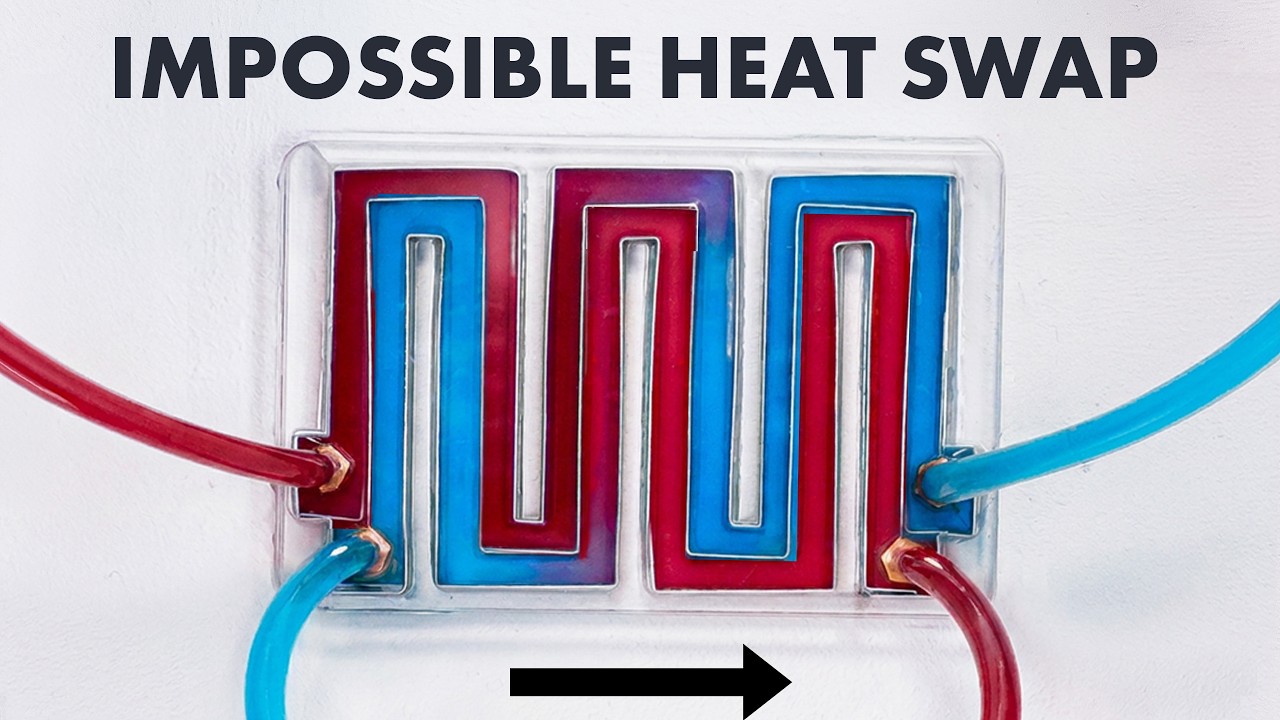
You pour hot tea and a cold drink through tubes side by side, and somehow the drink that started cold comes out hotter than the one that started hot. No heat pump, no power input, nothing mixed. It sounds like it breaks thermodynamics — but it's exactly what a counterflow heat exchanger does, and once you see why it works, you'll spot them everywhere.
What a Counterflow Heat Exchanger Actually Is
A heat exchanger is simply a device that transfers thermal energy between two fluids without letting them mix. The key word is counterflow — the two fluids travel in opposite directions. That one detail changes everything.
In a standard parallel-flow setup, both fluids enter at the same end, exchange heat as they travel, and approach a middle-ground temperature by the exit. The best you can do is meet in the middle.
Counterflow flips one of the streams. Now the coldest incoming fluid is always sitting next to fluid that's still relatively warm — all the way along the device. Heat keeps flowing the whole length instead of petering out, and the fluids can actually swap which one is hotter by the time they exit.
Why It Doesn't Violate the Second Law of Thermodynamics
The obvious objection: heat can't flow from cold to hot. And it doesn't — that's the neat part. At every point along the flow path, the hot channel is always slightly hotter than the cold channel right next to it. Heat moves in the right direction locally, but the geometry makes the overall effect look reversed at the exits.
Think of it like this: slow the flow rate down and the two temperature curves almost perfectly mirror each other along the exchanger's length. Speed it up too much and the system stops working — the fluids don't spend enough time in contact to fully exchange heat.
Real-World Uses (There Are More Than You Think)
Counterflow heat exchangers show up in a surprising number of places:
- Home-brew beer cooling: A copper inner tube carries hot wort while cold water spirals around the outside in the opposite direction, chilling the brew in one pass.
- Combi boilers: Ridged plates spread fluid over a large surface area; turbulent flow from the ridges makes the exchange even more efficient.
- Milk pasteurization: Incoming cold raw milk cools the just-pasteurized hot milk, recovering most of the heat energy for free.
- Duck and penguin feet: Cold blood returning from icy feet wraps around the warm arterial blood going down — pre-cooling it so the bird doesn't waste body heat on its extremities.
- Human kidneys: A counterflow exchanger in the renal medulla concentrates salt and urea without extra energy.
There's even a financial-market analogy: shares flowing one way, cash the other, intermediary traders in between — each with a "spread" equivalent to the temperature gap in the graph.
How Efficiency Scales With Flow Rate
At low flow rates, the two temperature curves along the exchanger's length nearly overlap — almost perfect exchange. At high flow rates, the curves diverge and the exit temperatures barely shift at all. The sweet spot depends on the pipe material (copper conducts heat far better than plastic), surface area, and how turbulent the flow is.
Industrial units like the plate heat exchangers in pasteurization plants add ridged surfaces specifically to promote turbulence, squeezing more exchange out of a compact frame.
The Takeaway
The counterflow heat exchanger is a beautiful example of geometry doing thermodynamic heavy lifting. By simply reversing the direction of one fluid, you go from "average out" to "completely swap." No extra energy, no magic — just physics being clever. Next time you use a combi boiler, drink pasteurized milk, or watch a duck stand on ice, you'll know what's quietly happening inside.
This article was created with AI help. If you want to watch the original video, please visit the link below.