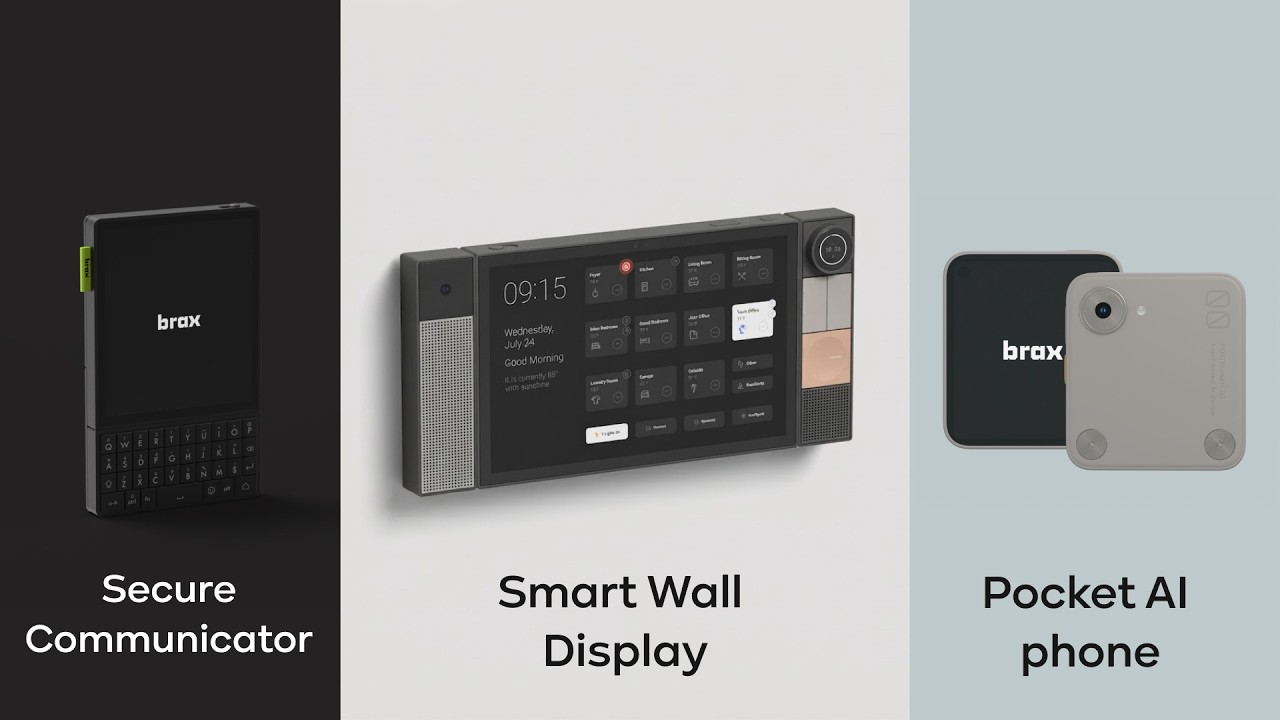
If you've been waiting for a real privacy-first alternative across smartphones, smart home panels, and AI — not just marketing claims — Brax Technologies just announced three devices worth watching. Rob Braxman's company revealed the Winq, Wallop, and Posthuman 00, all arriving in 2027 and all built on the same foundation: no Google, no cloud, no data leaving your hands.
The Winq: A Modular Phone That Physically Cuts Off
The Winq is the headline of the announcement. It's a compact 4-inch form-factor phone with a physical QWERTY keyboard — real keys you can feel and type on without staring at a screen. The standout feature is a hardware switch that cuts actual power to the cellular modem. Not software airplane mode politely asking the OS to behave — a physical power cut, so no cell tower can log your location because there's literally nothing transmitting.
It ships with de-Googled Android and two modes you switch between:
- Zero mode — stripped to the smallest attack surface possible; only vetted encrypted messengers and essential apps.
- Omni mode — full Android experience, no limitations, still no Google underneath.
Linux is officially supported on the same hardware. Calls run over VoIP on a number never tied to your name, so no carrier links your identity to your number. Winq is also set to be the first Android phone with fully open-source drivers, firmware, OS, and apps. The hardware is modular — clip on a battery pack over USB-C for a long day, remove it when you don't need it. Reservations are already open.
Wallop: Smart Home Automation Without the Surveillance Panel
Wallop is a self-hosted home automation panel, and the pitch cuts straight to the problem: every smart panel on the market is a window into someone else's server. Lose internet and it goes dark. Keep it plugged in and your motion events, voice commands, and sensor readings become telemetry for a company you didn't invite into your home.
Wallop runs everything locally. Automations, sensor readings, and voice processing happen on-device — your home data never leaves your home, and the panel keeps working when the internet drops. It speaks Home Assistant natively, so your existing entities and dashboards just appear. The hardware is modular: add speakers, a microphone array, a camera, motion sensors, proximity detectors, or a CO2 sensor depending on the room. Software is open source top to bottom — theme it, extend it, or load a different OS entirely. Planned for 2027, reservations open later this year.
Posthuman 00: On-Device AI That Doesn't Phone Home
The Posthuman 00 goes after every AI assistant that ships your words off to a data center. It packs roughly 50 TOPS of neural compute into a 4-inch phone body — enough to run powerful AI models entirely on-device, with no signal required. Your prompts never leave your pocket.
The privacy-by-design approach has a practical payoff: you can actually let the AI work with your real data — messages, photos, financial records — because nothing gets uploaded. Brax also promises you can build your own apps directly on the device, breaking out of the "use our app ecosystem or get nothing" model that's defined smartphones for two decades. It's a complete phone: full 5G, a dialer, open-source Android, and no subscription. Reservations open later this year; release is targeted for late 2027.
How Brax Funds All of This
Brax has never taken venture capital — every product was funded by the customers who bought the one before it. The company is now opening a community investing round, letting customers become owners of Brax Technologies. Full details and risk disclosures are at invest.braxtech.net.
Winq reservations are open now if you want in on the modular privacy phone. For Wallop and Posthuman 00, bookmark them — they're the most interesting 2027 releases in the privacy-tech space if these specs hold up at launch.
This article was created with AI help. If you want to watch the original video, please visit the link below.