Most people know their wall outlet delivers AC power, but why AC? And why do factories and industrial sites get "three-phase" while your home gets one? The answer starts inside a generator — and it explains nearly every design decision in the global power grid.
How a Generator Actually Makes Electricity
A generator has two main parts: the stator (fixed coils of wire) and the rotor (a rotating magnet in the center). As the magnet spins, its changing magnetic field disturbs electrons in the wire — Faraday's law in action — and that creates voltage. Connect a load, and current flows.
The magnet pushes electrons one way, then pulls them back as it completes each rotation. That push-pull cycle is what gives AC its signature sine wave shape. In North America it repeats 60 times per second (60 Hz); most of Europe and the rest of the world run at 50 Hz.
Single-Phase Is Simple — and a Little Wasteful
A single-phase system uses one coil and delivers power in pulses. Voltage and current both pass through zero twice per cycle, so there are brief instants where almost no power is delivered. For a lamp, that's fine — the bulb stays hot and the flicker is too fast to see. But try to start a motor on single-phase and it just vibrates in place with no idea which way to spin.
You can work around it with a capacitor and a second coil to fake a second phase, but that's a patch, not a solution.
Why Three-Phase Won
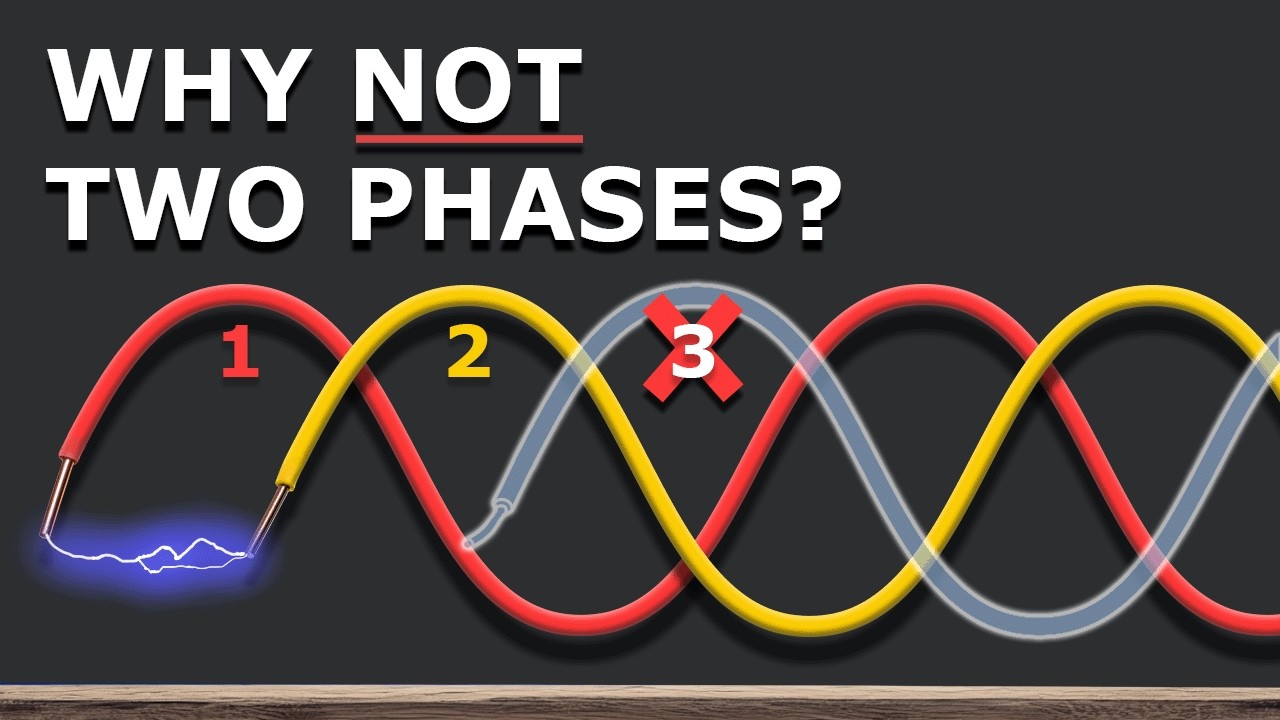
Add three sets of coils to the generator, spaced 120° apart, and you get three sine waves evenly staggered. The key insight: when you add their instantaneous power outputs together, the dips cancel out. Total power delivery becomes smooth and constant instead of pulsing.
That constant delivery means three-phase motors produce continuous torque without any capacitor tricks. They self-start and run more efficiently — which is why every factory, elevator, HVAC compressor, and fast EV charger runs on three-phase.
The economics seal the deal. Three-phase delivers three times the power of single-phase but costs only about 50% more in wiring material. Cost per kilowatt is the lowest of any system, and it beats two-phase in every metric.
How Power Gets from the Plant to Your Wall
Generators produce power at high voltage, which is stepped up further — into the hundreds of thousands of volts — for long-distance transmission. High voltage means low current, which means less energy lost to wire resistance over those long runs. Substations step the voltage back down as it nears the end user.
Industrial sites tap all three phases directly. For homes, a pole-mounted distribution transformer connects across one or two phases and steps the voltage down to safe levels — 120 V or 240 V depending on which part of the secondary winding you tap. The neutral at the center of the transformer's Y-winding is what gives you two voltage levels from a single unit.
The Bottom Line
Three-phase power exists because it's the most efficient way to deliver constant, high-power electricity over long distances and spin motors smoothly. The single-phase supply at your outlet is just a carefully extracted slice of that wider three-phase grid — simple by design, not by accident.
This article was created with AI help. If you want to watch the original video, please visit the link below.