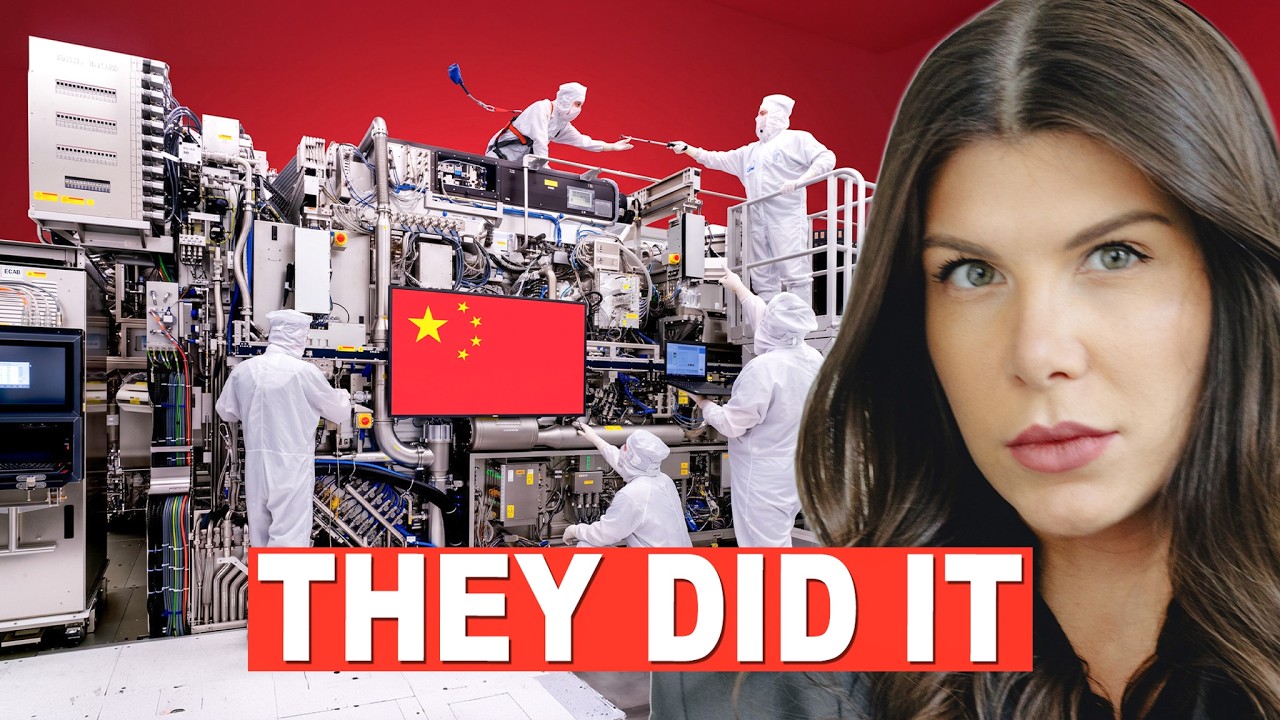
China has built its first domestic EUV lithography prototype — the machine that prints the world's most advanced chips. ASML spent decades and billions perfecting its version. China had to rebuild one from scratch, under export controls, without access to critical parts. The result is bigger, dimmer, and not yet factory-ready. But it works. Here's what's inside.
The Light Source: Same Goal, Two Very Different Paths
EUV lithography needs 13.5 nm light — and you can't buy that laser, you have to build one. ASML's approach fires 50,000 tin droplets per second into a vacuum, hits each with a CO2 laser, and collects the plasma flash. After decades of refinement, that system now outputs over 700 W of usable EUV power.
China is running two approaches simultaneously. The first follows ASML's LPP (Laser-Produced Plasma) method. The second — called LDP, or Laser-Induced Discharge Plasma — replaces flying droplets with rotating tin-coated discs and a massive capacitor bank that slams electrical current through a tin vapor cloud. Mechanically simpler, fewer moving targets, potentially more efficient. ASML tried LDP 20 years ago and abandoned it — not because the physics was wrong, but because they couldn't scale the power output. China is betting that 2026's engineering can clear the hurdle 2006 couldn't. Current prototype output sits around 100 W.
The Mirror Problem No One Can Shortcut
EUV light at 13.5 nm is absorbed by almost everything, including glass. So forget lenses — EUV machines use chains of precision mirrors, each built from alternating molybdenum and silicon layers, polished to within 50 picometers of flat. That's sub-atomic smoothness. For 30 years, one company knew how to do this reliably: Zeiss.
China's Changchun Optics Institute has built domestic EUV mirrors and integrated them into the prototype's optical system. They don't match Zeiss on reflectivity or long-term durability — yet. To compensate for lower efficiency, China went bigger: larger collectors, longer optical paths, more mirror surface area. That engineering trade-off likely explains why the Chinese prototype reportedly fills an entire factory floor while an ASML scanner ships on a flatbed truck.
Helium: The Invisible Choke Point
Even with a working light source and optics, EUV machines drink helium — a single advanced fab can need 5,000 to 20,000 cubic meters per month. Helium cools hot components, protects delicate coatings, and detects microscopic leaks. Nothing else does all three jobs. There is no substitute.
China imports about 85% of its helium, historically from Qatar and Russia — both supply chains now under pressure. Unlike oil, helium can't be warehoused long-term: stored as cryogenic liquid, it slowly boils off if transport is delayed. Beijing has reportedly imposed an emergency export ban to hoard every molecule for domestic chip factories. It's a vulnerability that can't be engineered around.
People Carry Knowledge Past Borders
Sanctions stop machines. They can't stop what engineers already know. China recruited experienced talent from overseas semiconductor programs — most notably Lin Nan, a former ASML engineer who worked on EUV light sources and returned to join the Shanghai Institute for Optics and Fine Mechanics. His team has since published research and filed patents at a rapid pace.
The numbers tell the story: China published relatively little EUV research before 2020. After that, dozens of teams began attacking different subsystems in parallel and the output curve went nearly vertical.
It Doesn't Need to Beat ASML to Win
China's EUV prototype doesn't have to out-perform ASML to be strategically meaningful. SMIC's current workaround — running wafers through older DUV machines four times — delivers below-50% yields and hits a hard physics ceiling. Even a below-spec domestic EUV scanner clears that bar. The goal isn't to sell machines on the open market; it's to build one China controls entirely.
ASML took roughly 12 years to go from first prototype to a commercial product. China will need time too. But this isn't a commercial program — it's a strategic one. The finish line is sovereignty, not market share.
This article was created with AI help. If you want to watch the original video, please visit the link below.